
How to Get Your Business Mentioned in AI Search Results
Why third-party mentions are becoming a core part of GEO—and which sources can influence how AI search engines understand your business.
If you are working on SEO for AI search, most of the advice you will come across is still focused on your own website. Improve your technical SEO. Add structured data. Make your content easier for AI to understand. Answer questions directly. Build topical authority.
All of that still matters.
Google itself says that traditional SEO fundamentals remain foundational to visibility in its generative AI search features. It also specifically recommends valuable, non-commodity content and a technically accessible website.
But there is another part of AI visibility that is much harder to control: What other websites are saying about you.
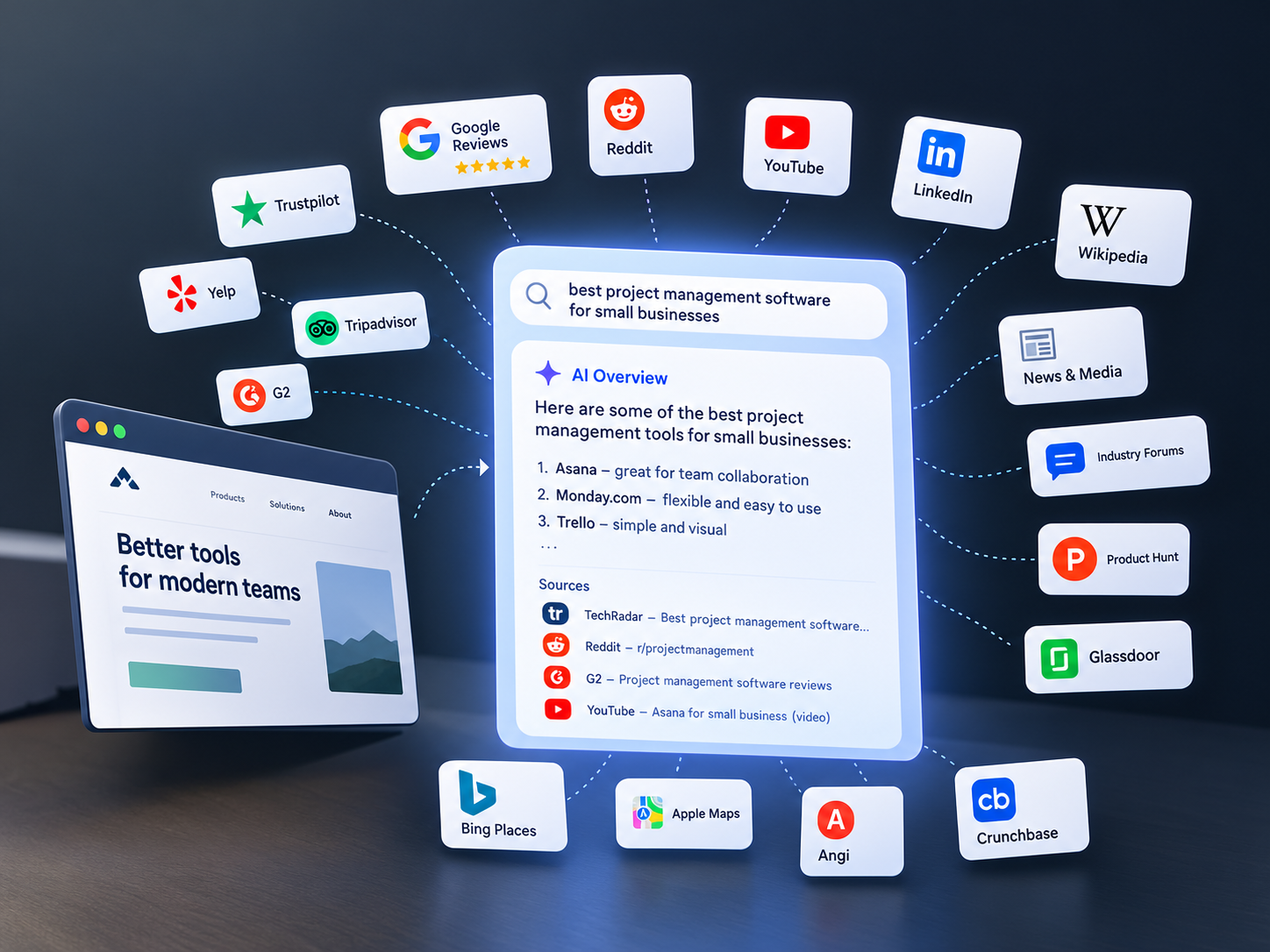
When someone asks an AI search engine to recommend a business, product, software platform, hotel, restaurant or service provider, your website is only one potential source of information. The model may also encounter your brand on Reddit, YouTube, LinkedIn, Google Business Profile, review websites, industry publications, comparison articles, forums and dozens of other sources.
That creates an important distinction between optimizing your website for AI search and building an online presence that AI search engines can discover and corroborate.
How Do AI Search Engines Decide Which Businesses to Recommend?
Traditional search is relatively easy to conceptualize. You search for something, Google retrieves relevant pages from its index, and those pages compete for visibility.
AI search is more complicated.
When an AI search engine answers a query such as: “What are the best SEO agencies for SaaS companies?”OR: “Which hotel should I stay at near Mussoorie?”, it does not necessarily need to find one page that contains the perfect answer.
Instead, the system can retrieve information from multiple sources and synthesize an answer. Google describes this process in its AI search documentation through concepts such as retrieval-augmented generation and query fan-out, where related searches can be generated to gather additional information before an answer is produced.
This means an AI system can potentially encounter a business through several different paths. Your website might explain what you sell. A review platform might provide customer feedback. A Reddit discussion might contain someone’s experience with your product. A YouTube video might demonstrate it.
None of those sources necessarily has to be controlled by you. And that is where third-party visibility becomes interesting for GEO.
Why Isn’t Your Website Enough for AI Search?
While your website is the foundation of your online entity, there is a difference between telling AI what your business is and giving AI independent evidence about your business.
Imagine two SaaS companies.
Company A has an extremely well-optimized website with detailed service pages, excellent internal linking, structured data and hundreds of articles. Company B has a similarly optimized website, but is also mentioned across industry publications, comparison websites, Reddit discussions, LinkedIn, YouTube and software review platforms.
When an AI system has to answer a recommendation query, Company B potentially has more publicly available context surrounding its entity.
This is not the same thing as saying that a particular third-party mention will cause an AI system to recommend a business. The systems are proprietary, retrieval varies by query, and correlation between a source appearing and a brand being recommended does not establish causation.
But the broader pattern is becoming increasingly difficult to ignore.
Search Engine Land’s review of AI visibility research reported that third-party websites were much more prominent sources of AI mentions than brand-owned domains. Its analysis also found Reddit, YouTube and LinkedIn among the most-cited sources across major AI platforms.
Neil Patel’s 2026 research on AI citation audits makes a similar point: the majority of citations driving AI responses typically come from third-party sources rather than brand-owned pages.
So the question is no longer simply:
“Is my website optimized for AI search?”
It is also:
“What does the rest of the web say about my business?”
What Third-Party Sources Can Influence AI Search Visibility?
Neil Patel recently published a list of 37 places AI may encounter information about a business. The list includes your own website plus 36 external sources ranging from Google Reviews and Reddit to Wikipedia, industry publications and podcasts.
I would not interpret the list as a definitive checklist of sources that every AI engine literally “checks.” There is no public master list like that, and retrieval behavior varies between platforms, queries and industries.
Instead, it is more useful as a third-party visibility audit framework.
Here is the full list, expanded with the types of information each source can potentially contribute.
| # | Source | Type | What it can tell AI about your business | Most relevant query types | Best fit |
|---|---|---|---|---|---|
| 1 | Your Website | First-party | Products, services, positioning, expertise, location, pricing, and factual information | Informational, commercial, transactional | Every business |
| 2 | Google Business Profile | Local / directory | Business category, location, hours, reviews, contact information and local relevance | Local, recommendation | Local businesses |
| 3 | Google Reviews | Reviews | Customer experiences, recurring strengths/weaknesses and sentiment | Recommendation, local, comparison | Consumer & local businesses |
| 4 | Google Maps | Local / maps | Location, proximity, category, business details and reviews | “Near me”, local, recommendation | Local businesses |
| 5 | Facebook Page | Social | Business information, updates, audience interaction and social presence | Recommendation, local, commercial | Consumer businesses |
| 6 | Social / visual | Brand identity, products, services, locations and audience engagement | Recommendation, commercial | Consumer / visual brands | |
| 7 | Linkedin Company Page | Professional social | Company description, industry, expertise, employees and professional activity | B2B, commercial, informational | B2B companies |
| 8 | YouTube Channel | Video | Demonstrations, explanations, reviews, expertise and brand information | Informational, commercial, comparison | Most industries |
| 9 | YouTube Transcripts | Video content | The actual words and topics discussed in videos | Informational, comparison | Expertise-led businesses |
| 10 | Yelp | Reviews / directory | Customer reviews, business category, location and service information | Local, recommendation | Local businesses |
| 11 | Trustpilot | Reviews | Customer sentiment, experiences and reputation | Recommendation, comparison | Consumer & SaaS |
| 12 | TripAdvisor | Travel / reviews | Guest experiences, ratings, location and travel recommendations | Travel, local, recommendation | Hotels, restaurants, attractions |
| 13 | Better Business Bureau | Business directory | Business identity, complaints, accreditation and reputation information | Reputation, recommendation | US businesses |
| 14 | Apple Maps | Local / maps | Business location, category, hours and local information | Local, “near me” | Local businesses |
| 15 | Bing Places | Local / directory | Business identity, location, category and hours | Local | Local businesses |
| 16 | Podcast Transcripts | Audio / editorial | Expert commentary, opinions, experience and brand mentions | Informational, expertise | Experts / founders |
| 17 | Wikipedia | Reference | Entity information, history, notable facts and relationships | Informational, entity | Established organizations |
| 18 | Reddit Threads | Community | First-hand experiences, opinions, recommendations and discussions | Recommendation, comparison | Products & services |
| 19 | Quora Answers | Q&A | First-hand explanations, expertise and answers to specific questions | Informational, commercial | Experts / services |
| 20 | Facebook Discussions | Community / social | User opinions, experiences and discussions | Recommendation, local | Consumer brands |
| 21 | Nextdoor | Local community | Local recommendations, neighborhood experiences and business discussions | Local, “near me” | Local services |
| 22 | Stack Exchange | Technical community | Technical expertise, problem-solving and specialist knowledge | Technical, informational | Software / technical businesses |
| 23 | Product Hunt | Product discovery | Product description, launch information, positioning and community response | Software, commercial, comparison | SaaS / startups |
| 24 | Industry Forums | Community | Specialist discussions, recommendations and expertise | Technical, commercial, informational | Niche industries |
| 25 | G2 | Software reviews | Product capabilities, customer reviews, alternatives and use cases | Software, comparison | SaaS |
| 26 | Capterra | Software directory | Product categories, features, reviews and comparisons | Software, commercial | SaaS |
| 27 | Clutch | B2B directory | Services, client reviews, specialties, locations and company information | B2B, commercial | Agencies / consultants |
| 28 | Glassdoor | Employer / reviews | Employee experiences, company information and workplace reputation | Employer / company research | Employers |
| 29 | Crunchbase | Company database | Company identity, funding, founders, industry and corporate relationships | Company research, B2B | Startups / companies |
| 30 | Indeed | Employment platform | Company information, jobs and employer-related information | Employer / company research | Employers |
| 31 | Angi | Local services | Service categories, reviews and local provider information | Local, recommendation | Home services |
| 32 | Thumbtack | Local services | Service offerings, pricing context, reviews and provider information | Local, recommendation | Service providers |
| 33 | News Articles | Earned media | Independent reporting, company mentions, events and expert commentary | Informational, commercial, reputation | Most established businesses |
| 34 | Trade Publications | Industry media | Specialist expertise, industry activity and professional credibility | B2B, technical, informational | Niche industries |
| 35 | “Best in Your City” Listicles | Editorial / comparison | Local recommendations, rankings and alternatives | Local, recommendation | Local businesses |
| 36 | Podcasts You Guested On | Earned media / audio | Expertise, opinions, experience and first-person commentary | Informational, expertise | Founders / experts |
| 37 | Wikidata | Structured knowledge graph | Entity relationships, identifiers and structured factual information | Entity / informational | Established entities |
The important thing about this table isn’t that every business needs to be present on all 37. A local restaurant and a B2B SaaS company should not have the same third-party visibility strategy.
A restaurant may care much more about Google Maps, Google Reviews, TripAdvisor, Yelp, Instagram and local publications. A SaaS company may care more about G2, Capterra, Reddit, YouTube, LinkedIn, Product Hunt, industry publications and comparison articles.
The query you are trying to appear for should determine which sources you investigate.
Which Third-Party Sources Matter for Different AI Search Queries?
One of the biggest mistakes I see with GEO is treating “AI search” as a single search engine.
It isn’t.
ChatGPT, Claude, Gemini and Perplexity have different retrieval systems, product designs and source patterns. Recent research from Meltwater, for example, found significant differences in which domains were cited across eight major AI platforms. In its August 2026 dataset, YouTube, Reddit and LinkedIn were the three most-cited individual domains overall—but their performance varied considerably by platform.
Neil Patel similarly notes that platform comparisons should be treated as snapshots because AI systems and their retrieval behavior change over time.
So instead of asking:
“Which website does ChatGPT trust?”
I think a more useful question is:
“Which sources are appearing when AI answers the types of questions my customers ask?”
This is where GEO starts to look a lot more like traditional search intent analysis.
Instead of building a list of keywords and then optimizing a page for each one, you can build a list of AI queries and identify which sources are repeatedly appearing in the answers. Those sources become your third-party visibility opportunities.
What’s the Difference Between an AI Mention and an AI Citation?
An AI mention is when your brand appears in an AI-generated answer.
A citation is when the AI response points to a source.
That source does not necessarily have to be your website.
For example, imagine someone asks:
“What are the best project management tools for marketing teams?”
The AI response could say:
“Asana is commonly used by marketing teams…”
and link to a G2 comparison page.
In that example:
- Asana received a mention.
- G2 received the citation.
- Asana’s own website may not have been cited at all.
Ahrefs makes a similar distinction in its AI visibility reporting, where a mention means the brand appears in an AI response while a citation refers to a page being used as a cited source. It also tracks pages that were retrieved but not ultimately cited. This distinction matters because the website that gets your brand mentioned is not necessarily the website that gets cited.
That is one of the strongest arguments for paying attention to third-party sources.
How Can You Build Third-Party Visibility for AI Search?
The answer isn’t to create hundreds of profiles and try to mention your own business everywhere.
In fact, Google explicitly warns against pursuing inauthentic mentions simply for generative AI visibility. Its guidance emphasizes high-quality content and warns that manipulating mentions is unlikely to be a useful long-term strategy.
Instead, I would break third-party visibility into five areas.
1. Earn mentions from relevant publications
Digital PR can put your business, founders or subject-matter experts in front of audiences outside your website. But the goal shouldn’t simply be “get a backlink.”
A relevant article can establish:
- what your company does
- what industry you operate in
- what you are known for
- who your experts are
- which problems you solve
- how you compare with alternatives
That context can be considerably more useful than another generic guest post.
2. Build a genuine review presence
Reviews are particularly important for businesses where customers make decisions based on experience. Depending on your industry, that could mean:
- Google Reviews
- Trustpilot
- G2
- Capterra
- Yelp
- TripAdvisor
- Clutch
- industry-specific review platforms
The objective isn’t to manufacture positive reviews. It is to make it easy for genuine customers to describe their experiences.
3. Become part of the conversations happening in your industry
Reddit, forums, Quora and specialist communities can be valuable because they contain information that doesn’t usually appear on corporate websites.
People ask:
“Has anyone actually used this?”
“Is this company worth it?”
“What would you choose between these two?”
“What’s the best tool for this specific situation?”
Those are exactly the kinds of questions that can lead to recommendations. But communities are also extremely good at identifying promotional content.
If your entire strategy is to create accounts and repeatedly recommend your own company, you are probably solving the wrong problem.
4. Create content on platforms AI already retrieves
Video is an obvious example.
Meltwater’s August 2026 research found YouTube was the most-cited individual domain in its dataset, followed by Reddit and LinkedIn.
That does not mean “move your entire content strategy to YouTube.” It means that if YouTube repeatedly appears when your target queries are analyzed, video may be an important additional source of discoverable information about your brand.
The same principle applies to LinkedIn, podcasts, industry publications and other platforms.
5. Make your information consistent
This is one of the less exciting parts of GEO, but potentially one of the most important.
If your website says you are a SaaS company based in London, your LinkedIn says New York, your Google Business Profile has an old address, and a directory lists a different company category, you have created conflicting information.
Third-party visibility isn’t simply about more mentions. It is also about consistent information across the web.
How Do You Measure Third-Party Visibility in AI Search?
Instead of only tracking whether your website ranks for a keyword, you can track:
1. Brand mentions
How often does your brand appear in AI-generated answers?
2. Citations
Which domains are being cited when your brand appears?
3. Source diversity
Are your AI appearances dependent on one or two websites, or are multiple independent sources contributing to your visibility?
4. Competitor mentions
Which sources are appearing when competitors are recommended but your brand isn’t?
5. Query-level visibility
For which specific questions does your brand appear?
6. Sentiment and context
Is the brand being mentioned positively, negatively or neutrally?
7. Citation-to-mention relationship
When your brand is mentioned, is the cited source your website, a third-party publication, a review platform, Reddit, YouTube or something else?
Tools such as Ahrefs’ Brand Radar now expose metrics including mentions, citations, impressions and AI Share of Voice, making this type of analysis easier to perform at scale.
But you don’t necessarily need an expensive tool to start.
You can manually build a spreadsheet containing 20–50 realistic AI queries related to your business. Run them across the AI platforms you care about.
| Query | AI platform | Brand mentioned? | Cited sources | Third-party source? | Competitors mentioned? |
|---|---|---|---|---|---|
| Best SEO agency for SaaS | ChatGPT | Yes | Industry publication | Yes | 3 |
| Best SEO agency for SaaS | Perplexity | No | Clutch | Yes | 4 |
| SEO consultant in Berlin | Gemini | Yes | LnkedIn | Yes | 2 |
| Best SEO agencies in London | ChatGPT | Yes | Clutch | Yes | 5 |
After enough queries, patterns start to emerge.
Maybe your competitors are repeatedly appearing in Clutch. Maybe Reddit dominates your product category. Maybe YouTube is disproportionately visible for informational queries. Maybe industry publications are responsible for most of the recommendations in your niche.
Those observations are far more actionable than simply knowing that your website has a certain number of backlinks.
What Does Third-Party SEO Mean for the Future of GEO?
I don’t think this means traditional SEO is becoming irrelevant.
Quite the opposite.
Your website still needs to be crawlable, technically sound, useful and authoritative. Google explicitly describes those fundamentals as the foundation for visibility in its generative AI search features.
What is changing is the scope of optimization.
Traditional SEO largely asks:
How can I make my page more visible?
GEO increasingly asks:
How can I make my business more visible across the information sources an AI system may use to answer a question?
That is precisely why these sources are worth paying attention to.
The next stage of GEO may not be about optimizing one page until it contains every possible answer. It may be about building a distributed presence across the information ecosystem surrounding your business.
The goal isn’t to get mentioned everywhere.
It is to make sure that when someone asks an AI system a question that matters to your business, there is enough relevant, accurate and independently published information about your brand for the system to find.
That is a much bigger SEO problem than optimizing a title tag.